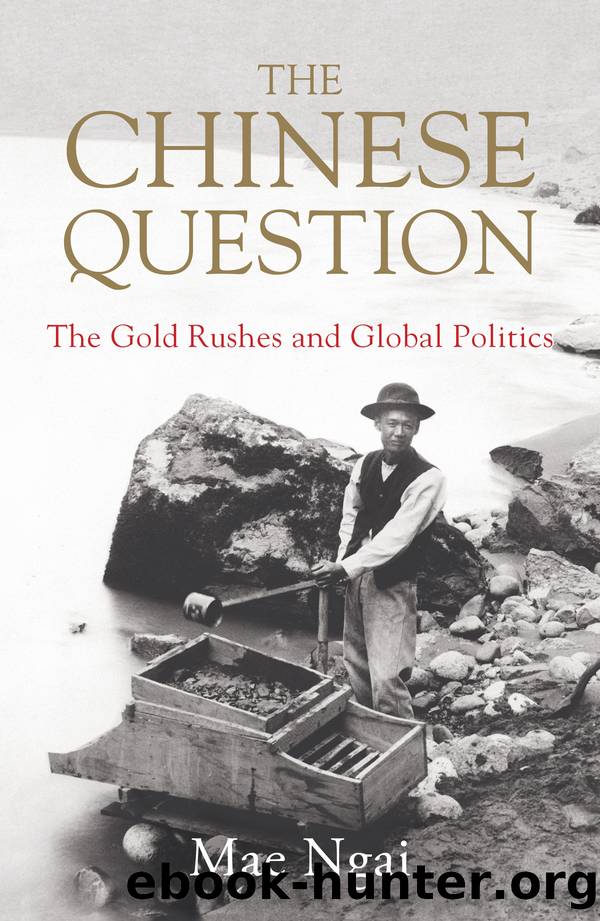
The Chinese Question by Mae Ngai
Author:Mae Ngai
Language: eng
Format: epub
Publisher: W. W. Norton & Company
Published: 2021-07-10T00:00:00+00:00
THROUGHOUT 1905 the mining companies and industry observers lauded the introduction of Chinese labor on the Rand. The recruitment of cheap, unskilled Chinese labor had solved the problem of labor shortage, restored profits to prewar levels, and enabled the expansion of deep-level mining operations. By the spring of 1905, the Engineering and Mining Journal reported that working costs on the Rand had dropped two to three shillings per ton from prewar levels and that the âmargin of profit is such and the scale of working is so great that [the deep-level] mines on the Rand are today paying out in dividends fully 30% of their total output.â19
These achievements came at the price of a worsening crisis of labor discipline and social control. A number of factors made containment difficult: relentless pressure to maximize production; ineffective Chinese policemen; and political sensitivity to charges of âslavery.â Mine managers and colonial authorities in South Africa grappled with the exigencies posed by the first two factors, whereas the colonial secretary in London considered the latter problem paramount. The differences in priority created rifts between London and Johannesburg that reflected growing tensions within the empire between imperial interests and those of the white settler colonies, tensions that had already led to the Australian colonies to seek autonomy as a federated dominion.
Lord Elgin, a Liberal who succeeded Lyttelton as colonial secretary in 1905, was especially defensive about the outcries in Great Britain about âChinese slaveryâ in South Africa. He refused proposals from Johannesburg that seemed to violate the individual rights of laborers, at least the most blatant ones. He also made some proposals of his own, aimed at quashing charges of slavery, in particular that Chinese laborers were detained in South Africa against their will. The press reported that Chinese labor recruits included artisans who were unaccustomed to manual labor and were unaware of the work that lay in store for them in the mines. Although the Ordinance of 1904 allowed for voluntary repatriation at the workerâs own expense (£17 6s., a considerable sum), it was said that many who wished to return home did not have the funds to do so. Elgin proposed that the government subsidize repatriation for any laborer lacking the funds to do so on his own. He believed such a provision would eliminate, âin one stroke,â all accusations that the British were keeping Chinese on the Rand against their will.20
Mine managers reacted with alarm, predicting a mass exodus from the mines and collapse of the industry. Taking a different tack, Jamieson said that the laborers would interpret the proposal as a trick to undermine their contracts and send them home against their will. He believed it was impossible to convey the sincerity of Elginâs motives to the âsuspicious Oriental mind.â All those actually desiring repatriation, he added, would claim they had no funds. Finally, Elgin and Selborne agreed to a policy that gave the appearance that no one would be kept against his will, while shifting the question of assistance to a case basis.
Download
This site does not store any files on its server. We only index and link to content provided by other sites. Please contact the content providers to delete copyright contents if any and email us, we'll remove relevant links or contents immediately.
| Anthropology | Archaeology |
| Philosophy | Politics & Government |
| Social Sciences | Sociology |
| Women's Studies |
Born to Run: by Christopher McDougall(7127)
The Leavers by Lisa Ko(6948)
iGen by Jean M. Twenge(5416)
Sapiens by Yuval Noah Harari(5370)
Spare by Prince Harry The Duke of Sussex(5197)
The Kite Runner by Khaled Hosseini(5179)
Machine Learning at Scale with H2O by Gregory Keys | David Whiting(4313)
Bullshit Jobs by David Graeber(4190)
Never by Ken Follett(3957)
Goodbye Paradise(3810)
Livewired by David Eagleman(3774)
Fairy Tale by Stephen King(3398)
A Dictionary of Sociology by Unknown(3085)
Harry Potter 4 - Harry Potter and The Goblet of Fire by J.K.Rowling(3073)
The Social Psychology of Inequality by Unknown(3031)
The Club by A.L. Brooks(2925)
Will by Will Smith(2920)
0041152001443424520 .pdf by Unknown(2845)
People of the Earth: An Introduction to World Prehistory by Dr. Brian Fagan & Nadia Durrani(2736)
